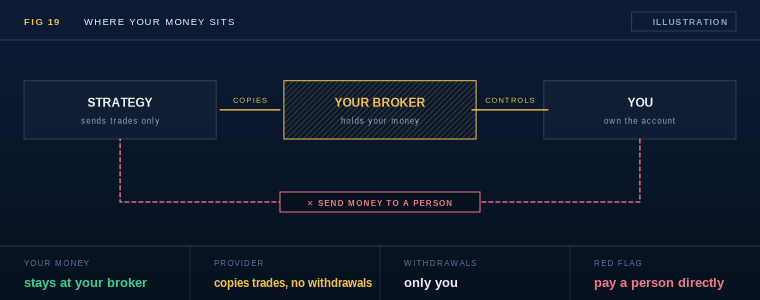
“Is copy trading a scam?” is one of the most-asked questions in retail trading, and it deserves an honest answer: no, the mechanism is legitimate, but it is also a favourite cover for people who are not. The job is learning to tell the two apart, and the dividing line is simpler than it looks.
01What copy trading actually is
Copy trading links your own brokerage account to a chosen strategy. When that strategy trades, your account mirrors it in proportion to your balance. Your funds stay in your own name, and you can stop at any time. It is offered through regulated brokers and platforms such as MetaTrader 5, and in its honest form it is simply a way to follow a track record you have chosen to trust. Nothing about that is a scam.
02Why it gets a bad name
The bad name comes from the operators. The recurring patterns are easy to list: signal sellers showing screenshots instead of a verified record; “gurus” promising fixed or guaranteed monthly returns; pressure to deposit quickly before a place “closes”; and, worst of all, requests to send money for someone else to trade on your behalf. None of these are copy trading. They are old confidence tricks borrowing its language, the same borrowing that makes people ask whether forex itself is a scam.
03The green flags
- A verified, live track record: pulled from a real broker account, not a screenshot. If you cannot read a verified record, treat the figures as marketing.
- A real, regulated broker holding your funds in your name, not a private wallet.
- Transparent drawdown: an honest strategy shows its worst moments, because drawdown, not return, defines a strategy.
- No guarantees: legitimate operators talk about risk, not promises.
04The red flags
Treat any one of these as a reason to walk away: guaranteed or “risk-free” returns; performance shown only as screenshots or a back-test; urgency and limited-time pressure; no way to see or verify the underlying account; and any arrangement where you hand custody of your money to a person rather than a regulated broker.
The risk sits with the operator, not the mechanism, and verifiability is how you tell one from the other.
05How to protect yourself
Verify before you fund: confirm the broker, read the track record, and judge whether it is good enough to allocate to. Then start small, keep control of your own account, watch the drawdown as closely as the gains, and make sure you can exit whenever you choose. Copy trading rewards the patient and the sceptical, in that order.
Nothing here is financial advice, and past performance (even when verified) is not a guarantee of future results. This is education.